Neuroengineering: Non-Invasive Intracranial Pressure (ICP) Sensing
Neuroengineering: Non-Invasive Intracranial Pressure (ICP) Sensing
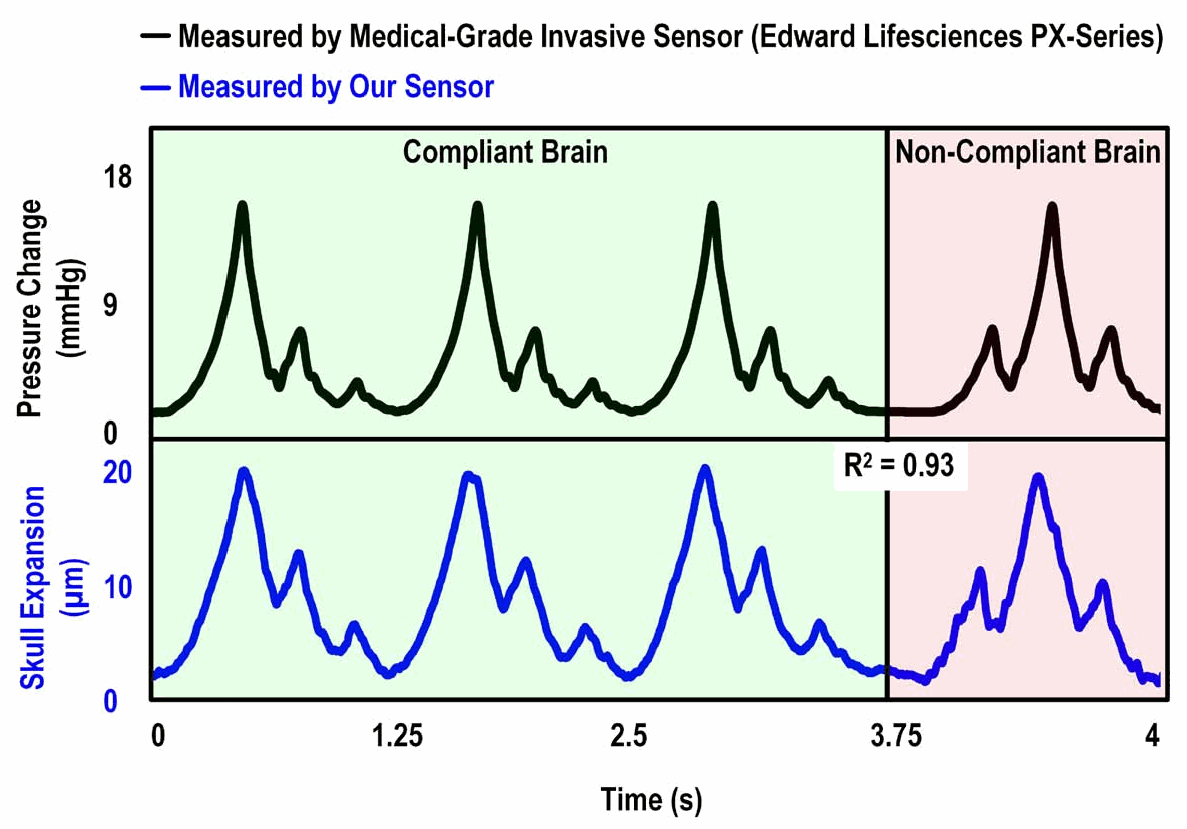
ICP waveforms benchmarked against a commercial, invasive ICP sensor.
9 mW DC power
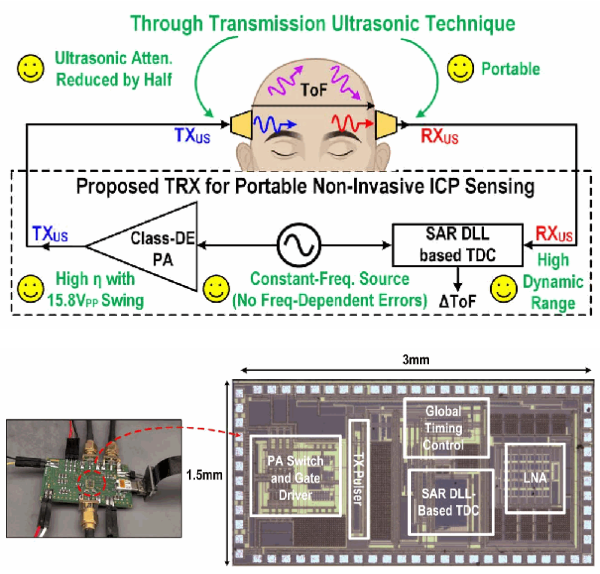
Clinicians routinely use ICP monitoring in neuro-ICUs because it provides actionable and timely information for patient care – the recovery of the ICP waveform morphology often suggests effective medical interventions. However, established clinical ICP monitoring methods require invasive procedures performed by experienced healthcare professionals, limiting their use in the field and in settings without specialist support. These constraints highlight the urgent need for portable, non-invasive ICP sensing methods.
In this work, we measure ICP waveform non-invasively by using ultrasound to track skull expansion. The transceiver chip drives an ultrasonic transducer through a Class-DE PA with 15.8VPP output swing and measures changes in the ultrasonic time of flight by a TDC. The sensor is validated through a human head phantom setup, demonstrating a high correlation of R² = 0.93 with a medical-grade invasive ICP sensor.