Security: Protection Against Wireless Eavesdropping
Security: Protection Against Wireless Eavesdropping
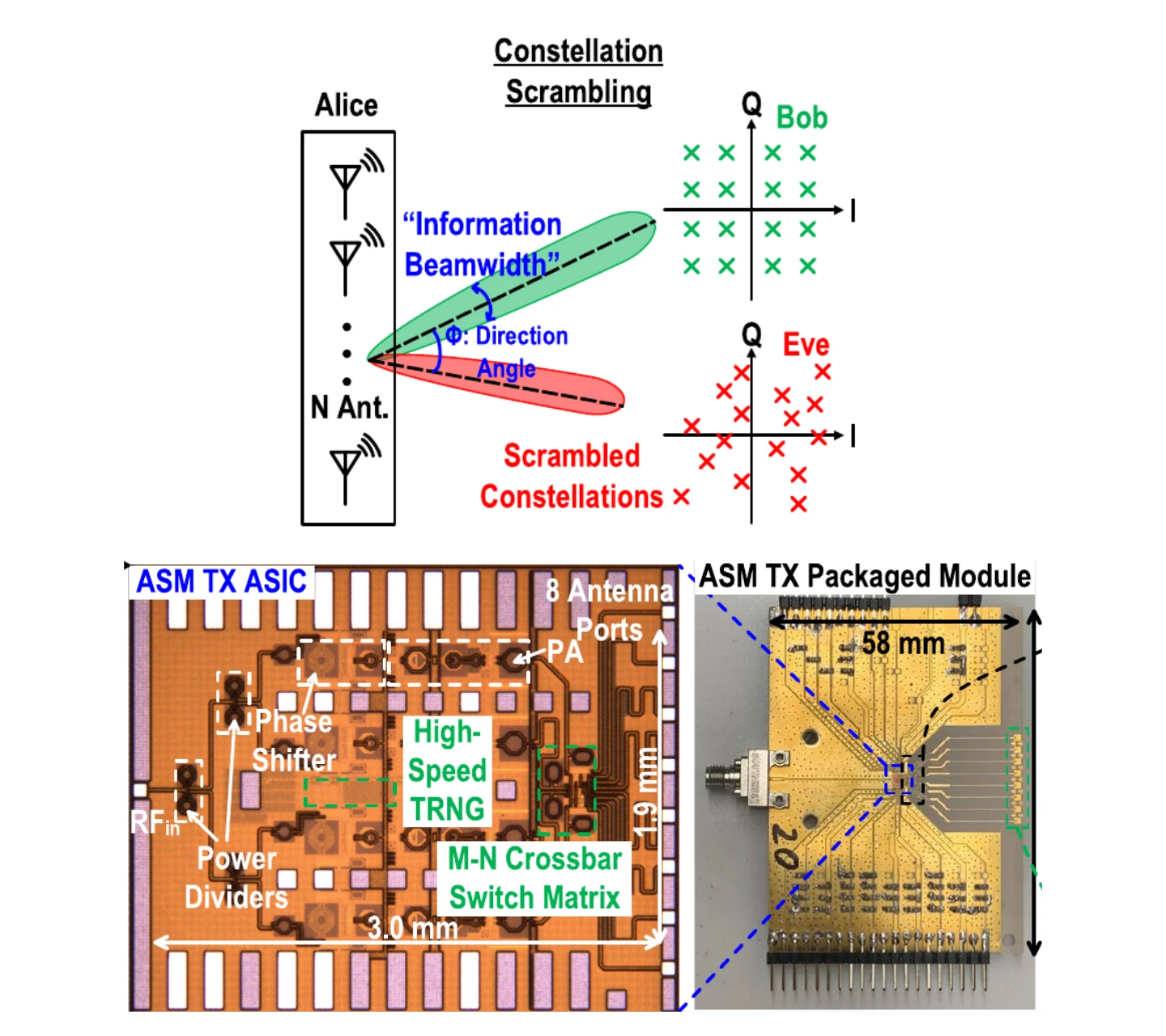
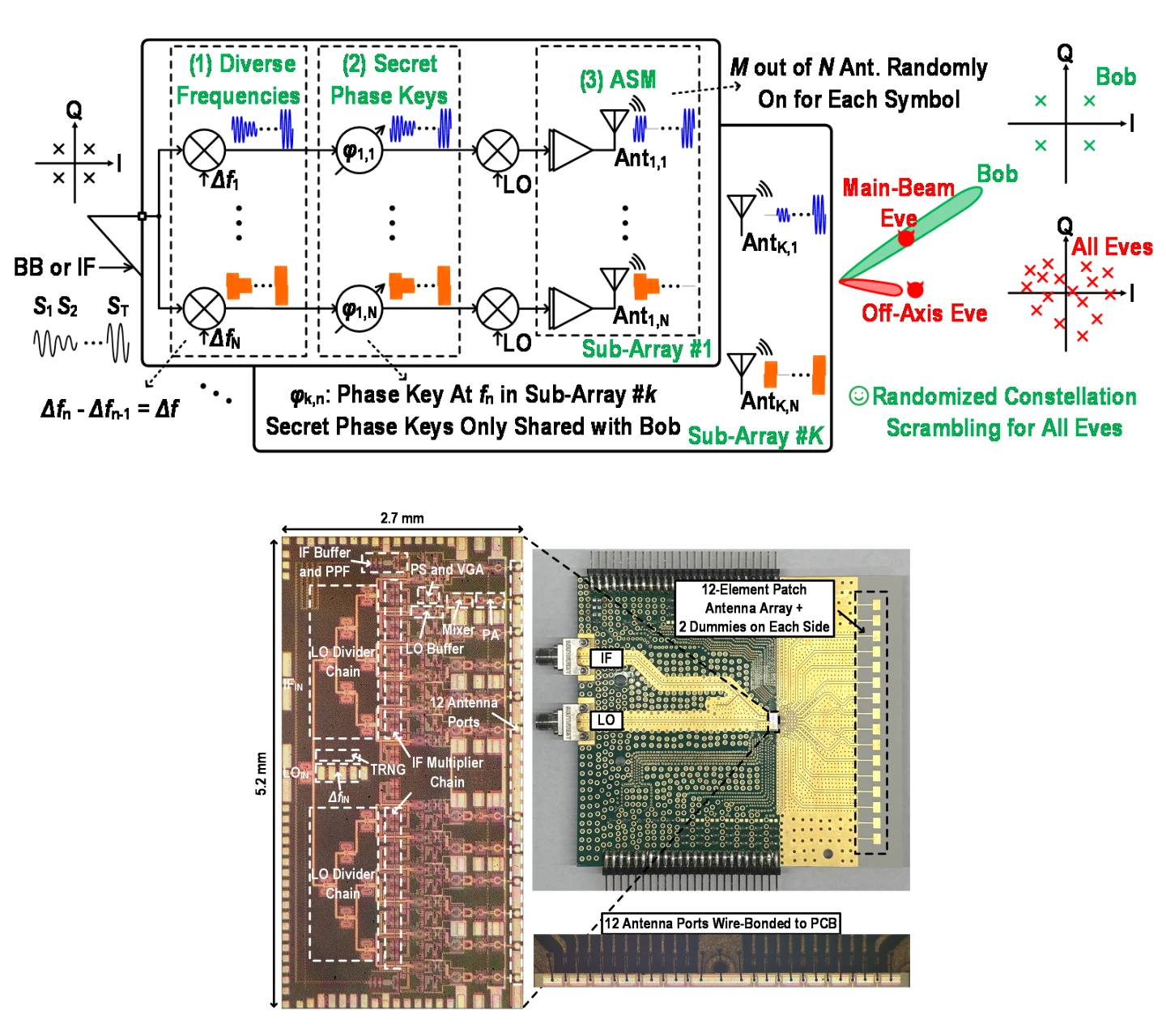
Physical-layer security has attracted growing interest within the wireless communication community. It can be either combined with conventional cryptography for enhanced, “two-factor” defenses or used to reduce encryption workload in energy-constrained systems. The latter is particularly attractive for mmWave communication, where real-time, multi-Gb/s encryption/decryption incurs significant power consumption and latency overhead.
We first developed a 28-GHz antenna subset modulation (ASM) transmitter that randomly selects the active antenna subset for each transmitted symbol. Signals from the active antennas combine coherently in the intended direction, preserving the desired constellation while scrambling the symbols received in other directions. Although this approach addresses off-axis interception, eavesdropping within the main beam remains a concern.
To address this limitation, we combined frequency-diverse sub-arrays, secret phase keys, and ASM. The intended receiver uses the shared phase keys to coherently combine the transmitted signals. Eavesdroppers without those keys experience constellation scrambling, including at locations within the main beam. Over-the-air measurements demonstrate resilience against both main-beam and off-axis eavesdropping, with only 2% DC power overhead compared to a conventional phased-array transmitter.