Design Automation: Surrogate Modeling and Inverse Design
Design Automation: Surrogate Modeling and Inverse Design
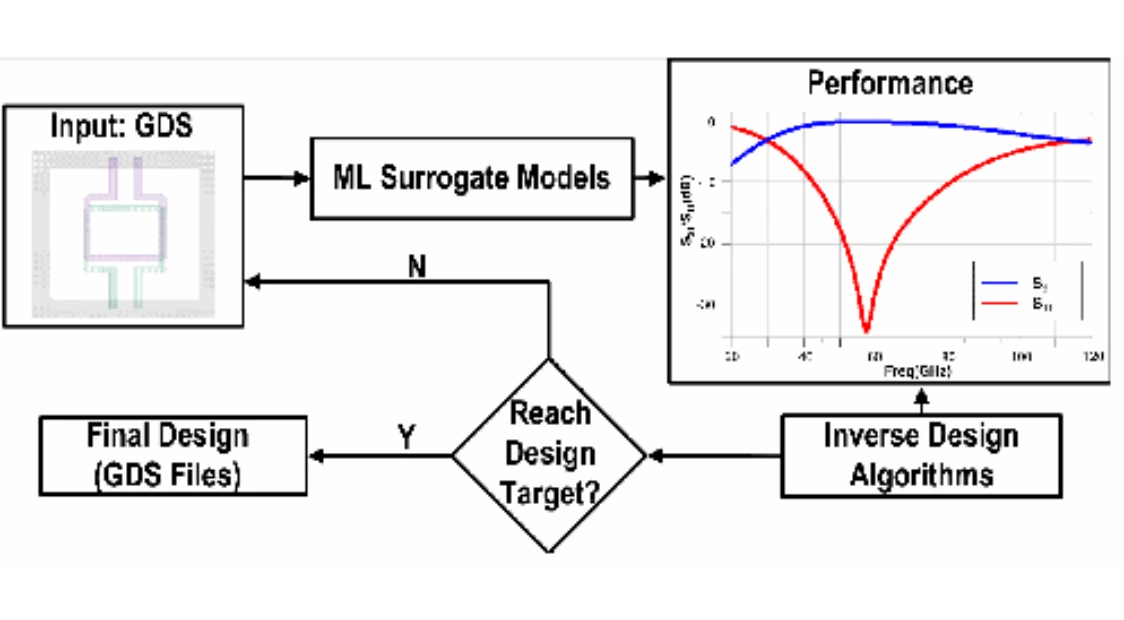
Passive components perform key functionalities at RF, such as impedance matching, filtering, power combining, harmonic shaping and so on. Automating passive-network design is a critical step toward a fully automated RFIC design flow. AI-assisted passive-network design typically involves two stages. First, ML surrogate models are trained to replace time-consuming EM simulations, enabling rapid and accurate performance evaluation. Second, optimization algorithms are applied to generate layouts that meet target specifications. This automated process is also referred to as “specs to GDS.”
MOTIF-RF focuses on multiple inductor / transformer templates and introduces a frequency-domain self-transfer learning technique that transfers learned knowledge between adjacent frequency bands. This technique reduces the prediction error of broadband S-parameters by 30–50%.
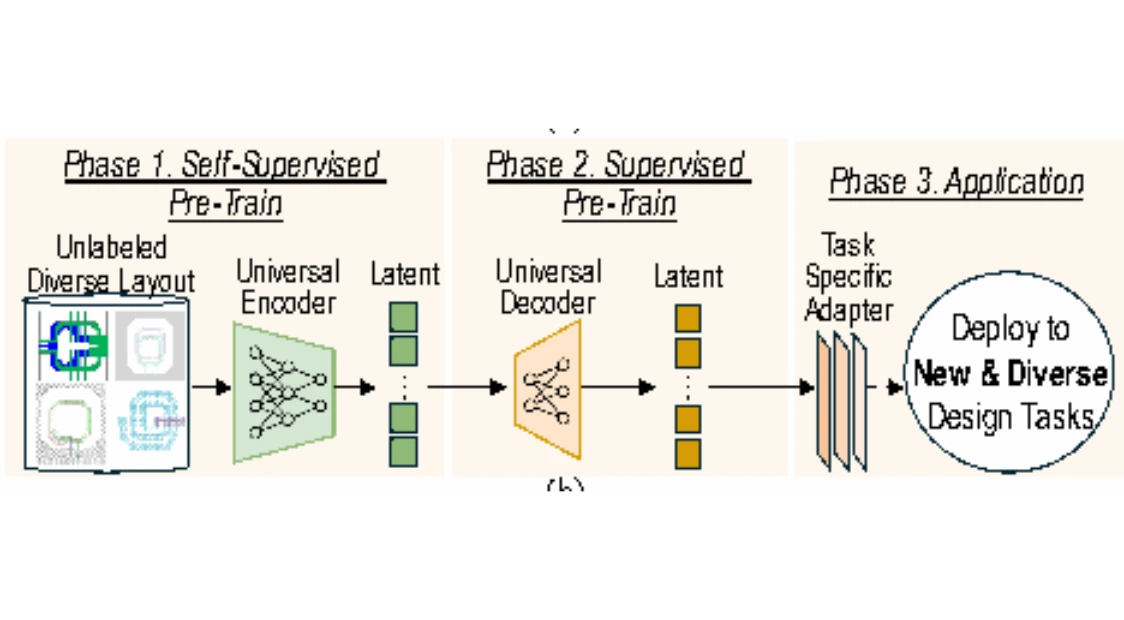
FoundaRF extends passive modeling beyond fixed topologies or process technologies. A self-supervised layout encoder, physics-aware decoder, and lightweight task-specific adapters enable transfer across topologies, physical dimensions, frequency ranges, and semiconductor technologies. In our evaluation, FoundaRF framework requires up to 4× fewer labeled samples and reduces prediction error by up to 3.3×.